Thursday, June 29, 2017

Antique cast-iron wood burning wood stove.  As you know, I am going to be remodeling my kitchen to accommodate my Kineo B wood burning cook stove.  You probably think I'm a little bit nuts for doing something like this.  Yup.  You probably are correct in that way.  I probably am a little bit nuts.  I think of it as a challenge.  I like keeping the old ways and the old skills alive.  In some ways we have become too dependent on modern conveniences and modern technology.  In many ways I do enjoy having modern conveniences.  I like having air conditioning and refrigeration and gasoline powered automobiles.  I really do.  I would hate to live like the Amish.  But, I recognize that all of those modern conveniences are based upon fossil fuels that aren't going to last forever.  And, when they run out the old skills will need to be re-learned.  People are going to need to preserve the knowledge that they developed over many years.  We don't need to reinvent the wheel.


The old cast iron cook stoves were developed in the 1800's as a direct result of the development of cast iron.  Iron foundrys were developed in the 1700's and really became prominent in the 1800's.  Cast iron became common during the 1800's and was used in many big construction projects, including bridges and skyscrapers.  One place cast iron came to be used was in the kitchen.  Pots, pans, kitchen utensils, and especially, the stove.  People had been cooking over the fire in the fireplace before this, which was very inefficient.  Almost all the heat energy went up the chimney.  The cast iron stove immediately changed that.  An air-tight wood stove can convert 80-90 percent of the heat energy of the wood into heat used in cooking and heating the room.  That's a huge improvement in efficiency.


The cast iron wood stoves continued to be sold until the early 1900's when gasoline became available and was cheap enough to be used, then electric stoves and natural gas stoves took their place.  Then the old cast iron stoves went out to the scrap yard.  Many of them ended up out in the wood shed or the dump out in the back yard.


Some intrepid soul in the Bangor, Maine Public Library scanned the 1912 catalog of the Noyes and Nutter Manufacturing Company in Bangor.  Here's the front of the catalog.
Noyes & Nutter
They scanned it, put it in .pdf format, and made it available on the internet for people like me to find.  So what, you may ask?  Well, as it happens, Noyes and Nutter is the company that manufactured the cast iron stove that I bought.  My Kineo B.  And, if you look in the catalog, on page 26, there it is!
There it is.  Page 26 in the catalog.
My Kineo B stove.  If you closely at the shelf in front of the oven door, you can see  the words, "Noyes & Nutter Manufacturing Bangor, Maine."
It's pretty cool, having that documentation.  In a way, it's hard to believe that wood stoves were still being manufactured that late.  I suppose there were some people that still were not connected to rural  electric clear up into the late 1950's that had to depend on kerosene lamps and wood stoves.  Noyes and Nutter went out of business during the Great Depression along with a lot of other companies.  People just weren't buying anything during those years.

Wednesday, June 28, 2017

Aquaponics.  This is my latest brainstorm.  As if I needed more hobbies and things to be involved with here on the Pearson farm, right?  For those of you that don't know what aquaponics is all about, I will give you a crash course.  You may be familiar with the term "hydroponics."  That is, growing vegetables and other plants in a water-based nutrient solution.  The problem has been that the plants produce waste products, and they use up the nutrients, so the water has to be renewed, and there's a lot of waste, and it's expensive to replace the nutrient solution.  Aquaponics solves a lot of those problems.  You raise fish in a tank.  The fish produce waste, the waste water is pumped over growing beds that grow plants.  The plants, and the microbes in the growing beds, and the worms in the growing beds utilize the waste products from the fish waste to produce vegetables.  The water is cleansed in the process, which then goes back into the fish tank, clean.  The water is completely recycled, except for what little evaporates.  The only thing that has to be added is the feed that is given the fish, since the plants live off of the fish waste.
Bathtub aquaponics.  The fish are in the tubs underneath.  The veggies live in the ones on top.  The water is pumped from the fish tanks to the grow beds on top, which then drains back down to the fish tanks underneath.
If you live in a tropical environment, you can do it this way.  But, not in Missouri.  Here, the weather is only warm enough to grow fish and plants for six months of the year.  The rest of the time you have to grow them indoors.  Therefore, the freezer.  The freezer, you ask?  Yup.  An old, broken-down chest freezer.  Doesn't work any more, but the insulation is great.  Which means that it holds the water temperature inside really well.  It's an 18 cubic foot chest freezer, which means it will hold about 100 gallons of water very nicely, and with two 300-watt aquarium heaters it will hold its temperature of 85 degrees year-round with very little electricity input.


Tilapia tank.  It may look like a chest freezer, but it's actually a tilapia fish tank for aquaponics.
The plan is to put two grow beds outdoors and grow veggies outside during the six months of warm weather, and then have two grow beds indoors and grow veggies indoors during the six months of cold winter weather.  You may ask, why bother to keep it going during the winter?  Why not just shut it down during the winter?  The answer to that is, that it takes 8-12 months for the fish to reach eating size.  If you start with baby fish in May when the weather gets warm, by the time the weather gets cold in October the fish won't be big enough to eat.  They would need another 4-6 months to get big enough to reach plate size.  Tilapia are the fastest to grow.  Catfish are even slower to grow. 12-18 months to reach full size.  If you let the water get cold, they stop growing.  They don't die, but they don't get any bigger.  So, that means it takes even longer.  The other option would be to buy bigger fish to start with, but then if you are going to do that, you might as well just go to the store and buy fish to eat.  The whole point of this is to have a whole system of growing fish and vegetables year round to grow and eat.

Barrel aquaponics.  I will be doing my barrel aquaponics indoors like this.
The barrels hold the gravel which is the grow beds for the plants.  The tank at the back holds the water from the fish tank, which flushes through the grow beds when the tank gets full.
This is more like what the outdoors grow beds will look like, except that the flush tank will be on top, at the far end.
The fish tank (the chest freezer) is inside the workshop, and the plumbing will run through the wall of the workshop to the outdoor grow beds.  Then, during the winter, I will drain all the water out of the outside grow beds, and switch everything to the inside grow beds.

Wednesday, June 21, 2017


I'm pretty upset with Phil.  Phil is the groundhog that lives at our place.  We named him after Punxsatawney Phil that predicts the coming of spring every year.  He eats our garden vegetables.  He particularly seems to enjoy the leaves on the broccoli plants, and yesterday he enjoyed eating the cucumber plants.
Phil
Brenda thinks Phil is kinda cute.  He's short, and fat, and he waddles when he walks around the yard.  But he leaves destruction in his wake.  Now I think I understand why my grandfather shot the groundhog when I was a little kid visiting those many years ago.  Only at the time he called it a woodchuck.  Same thing.  Phil lives in the cow shed down by my workshop.  He has dug himself a hole in the dirt floor.  Groundhogs are really good at digging.  Even in Ozarks rocky ground.  Phil may get evicted soon.
This is really gross.  This is the pig's head.  For head cheese.
You may ask, what on earth is head cheese, and why would anyone want to eat it?  Well, why does anyone eat hot dogs, or bologna?  Because they taste good, and because they are convenient foods to eat, of course.  That's why.  There's a lot of good meat on the pig's head, and a frugal farmer is not going to throw away good food.  So, you are going to put the pig's head in the oven to cook for a few hours until it is very soft and falling off the bones.  Then you let the meat cool, then chop the meat up fine, mix it with spices, put it in a bread pan and refrigerate until it sets up firm like gelatin, and then slice it.  Then, package it in slices like bologna for sandwiches, or for frying for breakfast.  You probably wouldn't want to serve the pig's head like this to guests.
My new Kineo B wood-fired cook stove
This is my new cook stove.  It came in the mail two weeks ago.  It weighs about 400 pounds.  All cast iron.  It was made sometime around 1900 by the Noyes and Nutter Manufacturing Company in Bangor, Maine.  It's called a "half back" because the back goes up half-way, instead of having a tall back.  It has a nice thermostat on the oven door, which is handy, and a nice shelf on the right side for setting hot dishes off the stove if you want them to stop cooking.  It has two shelves above the stove for warming food, such as for rising bread when you are getting ready to bake, or for keeping food hot, like when you are making lots of pancakes and need to pile them up someplace but want to keep them warm.
We are going to be remodeling the kitchen this summer to accommodate this stove, as there is no room for it right now.  It is sitting in its shipping container in the garage.  The plan is for it to be in the center of the house, so that when it is fired up, it will provide warmth and good smells that will fill the whole house.

Tuesday, June 20, 2017

         It's been a while since the last time I posted on this blog, so it's taking me some time to figure out how the thing works, so please be patient.  I remember now that there are two different ways of writing, one is called HTML, and then the other is just "compose" and they come out very different.  The HTML does not allow normal punctuation and paragraphs and so on, so everything come out in one long run-on sentence, which is not very readable.  So, today, we will try making things more in a readable format.
         Pictures.  I was discussing pictures with Brenda yesterday after I got home.  Blogs are not readable without pictures.  No one wants to read blogs without pictures.  They are like deserts.  Deserts.  Not desserts.  So, I will be taking lots of photos at home, and then loading them, and then sharing them here.  Lots of photos.  That's the only way to really communicate.  As the saying goes, a picture is worth a thousand words.  At least a thousand.
This is my herb garden.  I enjoy growing herbs.  I don't always use them for cooking.  Sometimes I do, but lots of times I just enjoy growing them because they are beautiful plants, they smell wonderful, and they look so good.  I have parsley, rosemary, basil, thyme, cilantro, sage, and tarragon.  The nasturtiums, zinnias and marigolds are for flowers, although I am told that nasturtiums have a peppery taste in salads.  The plant in front is kalanchoe, not an herb or flower, just a succulent.  It was a survivor from the previous owner.  I also have chives, which have survived from several years' of growth.  They bloom every year, and they just keep coming back.  All the herbs I grew from seed this year.  The seed packets said they were very difficult to get them to germinate, but we had about two weeks of very cool, wet weather right when I planted them, and they all came up in the first week except the rosemary, which took another week to germinate.
Coffee tree.  This coffee tree has a long history.  It is more than ten years old, although it is still pretty small.  Brenda and I bought this thing when we were on our honeymoon in Hawaii in 2004.  Yup.  That's 13+ years ago, now.  We had it in a little tiny pot for about ten years, and for some strange reason it never seemed to get any larger.  Strange.  Then, when we moved to this house a year ago, we left it sitting outside.  That was in February.  Yes, February.  I figured the thing was dead for sure.  So, I didn't even think about it until later that summer when I was cleaning out some junk out back and saw that it was putting out new leaves!  It was ALIVE!  Yes, the coffee tree that refused to die.  So, I re-potted it, took care of it, I was real nice to it, and it took off, put on all kinds of new growth, and went from a little dead stick to a beautiful coffee tree again.  Then, this spring we got it this nice big planter and some nice new potting soil for it to grow in, and it has really taken off.  It has grown at least another foot since this spring, and I'm pretty sure it will put on at least another two to three feet of growth by the end of the year.  I'm thinking we may see coffee flowers and fruit this winter.  We will, of course, be moving it indoors when the weather gets cold this time.

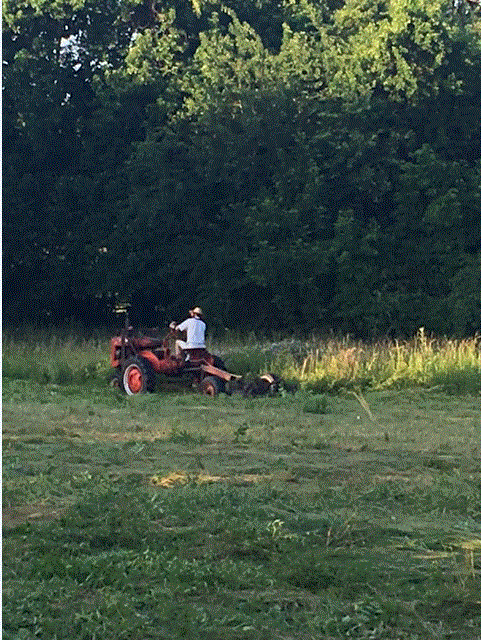
Mark mowing.  This is Mark mowing with the sickle bar mower.  As with everything else around the farm, there's a long story attached here.  As you may recall, we now have 14 acres, and about 10 acres of that is brush that needs to be mowed at least two to three times a year to keep it from growing into forest.  I suppose it would be okay for it to be forest, but we don't really want it to be forest, we would prefer it to be pasture, or hay fields.  So, that means it needs to be mowed.  That means it has to have a tractor.  That's my tractor in the photo.  It's my 1945 B Farmall.  For those of you who may not be familiar with Farmall tractors, what that means is, that the rear end of the tractor is real wide, as you may be able to see in the photo, and the seat is offset to the right, and that is supposed to make it easy for the farmer to see the crops as the tractor goes over them, so that he drives the tractor between the rows and not over the top of the plants.  Anyways, that's what a B Farmall is.  Well, my tractor wasn't running this year, it needed work.  So, it got later and later in the year and the grass got higher and higher.  Finally, my very kind elderly neighbor, Mr. Forrest, came over and helped me do the tune-up it needed and got the tractor running so I could do the mowing.  Then, because the grass was so high and so thick and heavy, I broke the U-joint on the bush hog mower.  Twice.  The first time wasn't so bad, it was only $10 to fix it.  The second time was much worse, it twisted the second half off, also, so it was $60 to fix it.  That did it.  So, now I had to get the sickle bar mower out, since the bush hog mower just won't handle that heavy grass.  Therefore, the above photo.  It has been several years since I last had used the sickle bar mower and it needed some repairs.  The mold board had rotted away and had to be  replaced, and the transport bar had broken when we moved (that was exciting! It took off a mailbox when it suddenly extended down as we were going down the highway at 45 mph!).  So, that meant getting out the welder and doing some grinding and welding, and then fabricating a new mold board out of exterior grade plywood, and then finding a nut and bolt to fit.  But, after getting it all put together, and dribbling some 10W40 motor oil over everything and starting it up, it ran! 
The down side was, two days later, I discovered that there must have been poison ivy in all that grass, because I had to go to the doctor for some medicine, as I had poison ivy rash all over me.  So it goes.  No photo of the rash.  Sorry.

Monday, June 19, 2017

Everything's new. Everything's changed. We have moved. The Lord God made it clear to us in many different ways that we needed to move to a different house and property, so we picked up and moved to Willard, Missouri a year ago. It's kind of at the other corner of the Springfield. Instead of being at the northeastern side of Springfield, Willard is at the far northwestern corner of Springfield. Actually, we are about five miles north of Willard, which puts us nearly at the north edge of Greene county. So, you my ask, why am I even bothering to pick up this farm blog, anyway? Good question. Two answers. One, I always do like to write about all the projects I have going on at the farm, I guess I get that from my father. And, two, I recently purchased another wood-fired cookstove and we will be installing it in the kitchen during the summer when we remodel the kitchen and living room, and I enjoy writing about my cooking adventures with the wood and cooking on the stove. I don't have very many photos of the new house to share, but what I do have, I will attach. More photos to come. New potatoes. Now new potatoes may not mean much to some of you, but for those of you that have had new potatoes, there's really nothing like the flavor of new potatoes freshly dug from the garden. It's a little hard to explain at this point, so I guess it's best to just start at the beginning. This is the best photo I have of the new house right now. I'll get a better one later. The Lord God led Brenda and I to this listing at exactly the same time a year ago. The house was a mess, but we were convinced that it was right for us, so we bought it. It has a huge heating fireplace upstairs, which has been a real blessing this last winter. It has a really big kitchen, which I love. And, I will be installing a wood stove in the kitchen this summer, and we will be enlarging the living room to make more space for living room furniture. So, all in all, it has worked out just right for us. We have 14 acres here, which is more than enough space. We had 12 1/2 acres before, but we were getting new construction on both sides of us before, so it was getting closed in. Here, the trees keep us very private. Lots of farm land, wide open space. The farm pond is full of big trees, so it will need to be dug out and rebuilt, but no rush on that. We raised a pig last year and butchered it. About 400 pounds, I would guess. It was huge. Massive. I was blessed by some good friends from church who came to help me butcher it. I could never have done it by myself. It took us about five hours to do the job. It was exhausting. It was well after dark by the time we were done. We gave a lot of the meat away to the friends who helped me with the job, and we have since given away a lot of the meat to friends and family. We still have hundreds of pounds in the deep freezer, so we aren't going to raise another pig until this meat is consumed. We are still working on the rabbits, the deer, and the sheep from last year. Rabbits. Wow. Rabbits. We got four rabbits from some friends. Two of them were really good at having baby bunnies. Really good. We got 40 babies in one year. That's a lot of rabbit. We still have rabbit in the freezer. It's really good. Tastes like chicken. I'll bet you didn't know that a rabbit has white meat just like a chicken, but in a different place. That's true. On a rabbit the white meat is along the spine, on the back. Beautiful white meat, just like a chicken breast. Since we have so much meat in the freezer I decided I would concentrate on the vegetable garden this year. I am doing something new, called a drip watering system. You may be familiar with a soaker hose? Well, a drip watering system is better. It has a tiny hole about every 8 to 12 inches, and it's on a very low pressure system, so the water just drips (right!) out very slowly. You lay out a line along each row of vegetables, so that the water goes directly to the row of plants. That way the water goes only to the plants, not to the ground in between. It's much more efficient than the old water sprinkler, where you would put a sprinkler somewhere in the middle of the garden, hoping to cover most of the garden. Turn the water on all the way. The garden right in the middle gets sopping wet. The garden at the edges stays bone dry. All the paths get lots of water, even though they don't need to be watered. Very inefficient. This is much better. Early girl tomato. Ripe tomato 50 days after transplanting. That's what it says. I guess we'll see. Right now I have several tomatoes on my Early Girl plants and it's been about four weeks since transplanting, so we may make it.

Wednesday, December 17, 2014

It's the Holiday Season, Merry Christmas!

One week til Christmas. I do have some Christmas presents to purchase, yet. But, I do want to talk about events over the last few weeks. I see that it has been several weeks since my last post, as usual, that is because I have to remember to download photos off of my camera so that I can include them in my posts. Without pictures, the posts can be pretty hard to swallow.

1969 Jaguar XKE, 2+2 with factory air and manual 4 speed transmission.
 Yes, it is mine. Sort of. Actually, the bank owns it for right now. I bought it last week. It has 19,000 miles on the odometer. Everything works. It's kind of like sitting in a fighter jet plane. Very comfortable. I plan to drive it on a regular basis. You can actually get two child car seats in the back seat (proved it last Sunday). They say it will get up to 25 miles per gallon on the highway.
A really cool fall morning on the Pearson farm.  This is one of the many pleasures we enjoy from being out here in the country.
Now that the weather is cooling off, it is time to get the old wood cookstove fired up again.
Starts off with a Wal-Mart bag of apples from a friend at church, Beth Williamson.  The evaporated milk was for the pumpkin pies. The bowl on the floor is to catch the peels as they come off of the apple peeler.
Thank the Lord, my old loose-leaf Betty Crocker cookbook has a recipe for deep-dish apple pie.

Next, comes in an antique apple peeler.  It took me a couple of apples to get the hang of it, but actually works great.  It has one knife that pushes the peel off as you crank, another one that takes the peel off from around the stem end, and then when it finishes, it has a "pusher" that pushes the peeled apple off of the holder.  Pretty cool, huh?
15 tart apples and a couple hours of peeling, cutting, trimming and you have the apples for a deep dish apple pie.


Once the apples are peeled, I cut them and core them with a (modern) apple corer and then trim off the brown spots and cut them up into small bits.  Now, I have apples for pie and a bowl full of peels, cores, stems and trimmings.  Wait a minute!  Can't I make apple jelly from that?!
 Yes, I can! Of course, now I have to go way back to my old Searchlight cookbook from the 1800s for a recipe for apple jelly. It did jell, but a bit too soft. More like apple syrup, actually. But, still quite good. Better than just throwing it all out. After I got done with making the jelly the pigs got it, anyway. So, both of


It actually started out on the electric stove (old habits die hard) and then it occurred to me that I have the wood stove going for the pies, why not cook the apples there?  Duh!
 us got to benefit from it. Nothing wasted.


One tasty deep-dish apple pie.
 Once I had the apple pie in the cookstove oven I turned my attention to the pumpkin pies. I have enough pumpkin from our Jack-o-lanterns to do several pies, but I limited myself to just 3. Be reasonable!


One apple pie and 3 pumpkin pies. Again, the electric stove comes in handy when you need a heat-proof spot to cool pies.
 Again, as I have posted in the past, I got a great tip from my fellow wood cookstove buff, Jim, at http://woodcookstovecooking.blogspot.com/. He gave me the idea when he was trying to get the excess water out of tomatoes, trying to make homemade ketchup. After the pumpkin is cooked and scraped off of the skin I put it into a jelly bag (old T-shirt) and let it drain overnight. Then I squeeze as much water out of the jelly bag as I can with my hands. The result is much drier and makes for a much better pie (more stuff, less water). I like it and the pies taste much better, too. I just mush it up with my hands rather than running it through the food processor. Too much work. Hands are cheap and easy, and it gives the pie better texture (more tooth).


Thanksgiving dinner at grandma and grandpa's house.  From right to left, my wife, Brenda, on the far right, then Maddie (foster child), then sons Adam and Andrew.


Tuesday, October 7, 2014

Fall is in the air.

Now that fall is in the air, we have a lot of projects that need to get done before winter. First, the 20 or so roosters that we still have around will need to be dressed (or un-dressed, so to speak) and put in the freezer. I did 3 of them 10 days ago, plucked, gutted and put away. I did 3 more last Saturday, this time I skinned them instead of plucking, as I have heard that skinning is so much faster. Not! It ended up taking exactly the same amount of time as plucking, and it was much more physical hard work. So, back to plucking.


A nice young man from church comes over sometimes to mow.  He was here, so he got the opportunity to help pluck chickens.  He will never look at a chicken dinner the same after this.  I am dipping the next "victim" in scalding water in preparation for the plucking.

Next, the pigs are out. Not out of our property, but out of the electric fenced area, about one acre. Over the summer the grass grew so thick around the electric wires that it weighed the wires down to the ground. So the pigs eventually figured out that it wasn't working any more, so they went exploring. So, right now, we keep the front gate closed all the time, even when we are home, so the pigs won't escape. For the time being, they have not tried to go through the barbed wire, although it wouldn't take much for them to do that. It's not too bad right now, but I can see that this is not a long-term solution, so I will have to mow down the grass that has grown over the electric fence so that it will be working again. I did spray the grass along the fence with Rounduup, which actually worked very well to kill the grass, but it didn't magically disappear like I was hoping for, so I still have to mow it down. Hopefully, next spring it won't grow back in the same spot. The pigs don't really cause any havoc, but it is a bit unnerving to walk out the front door and have two 500 pound pigs standing there on the front walk, staring you in the eye. The upside is that they are finding lots of good things to eat, so we haven't had to feed them nearly as much over the last 2-3 weeks. The other downside is, that they don't always hold it until they get back to their area, so we have to watch where we step. It's not quite the same as a dog.


It's bad enough having chickens in the front yard.  Pigs is, well, it's just too much.

Next, the hay needs to be stacked. I mowed the upper half of the property about a week ago, and it is dry enough now to stack on the haystack I made some weeks ago. Since I made it, rain and time have gradually worked on it, so that a 10 foot high stack is now about 5 feet high. I will also need to mow the lower 5 acres, as it did not get mowed and baled this year. The elderly fellow that used to do it with his grandson died this summer and apparently the grandson isn't interested. Which is okay, as I plan to start using the hay myself.

Next, the bees have worked their magic again this year, and I need to get the honey super off of the hive and extract the golden sweetness and get it put up in jars.

Next, the new hens are starting to lay. So, once the new roosters are in the freezer, I will need to move the hens to the lower chicken house for the winter, as it is insulated. The summer house is uninsulated and I don't want them to freeze. They don't have a nesting box, so they have been laying in the bed of the pickup truck and on the shelf in the tractor shed. We have been getting from 5 to 8 eggs a day for the last week, so we have given away a bunch of eggs. They build up fast!

Next, every time I go out to where the walnut trees are I nearly break my ankles on all the walnuts. This is walnut buying week, which we missed last year. So, I need to get out there and get them picked up and take them to the walnut buyers and see if I can get some cash for them, rather that just using them to fill pot holes in the driveway, which is what happened to them last year.

Next, the swimming pool is pretty much ready for winter, but I would like to put a leaf net over it to try to keep the leaves from accumulating on the bottom of the pool, which is what happened last year. We closed up the pool a few weeks ago when it got cold and took out the pump and drained the water out of the filter. Then the weather turned warm again and the water all turned green. So we added a bunch of chlorine powder a few days ago to try to keep it from getting too green until the weather gets cold again.

Next, since the weather is starting to get cool, I am going to start using the woodfired cookstove again, which is really nice on a cold Saturday morning. So that means I need to start cutting firewood. The huge dead walnut tree about halfway down the driveway still has several more branches that can be cut and split into firewood. Last winter I went the whole winter burning wood in the cookstove and the fireplace all on just one branch from that tree. The trunk at the bottom is about 4 feet across, and each one of the branches is about 2 feet across.

Next, the pond is nowhere near as full as it should be. I have finally concluded that it will have to be drained and re-built. It fills when it rains, but then the water leaks out again until it gets to where it is now, which is about 5 feet of water. It should have about 10-12 feet of water. I don't know for sure where the leak is, but I am pretty sure it is in the area of the big bedrock rise in the middle of the pond. The fellow who built it the first time told me that that could be a problem. What he should have done is to dig out all the bedrock that sticks up in the middle of the pond and then seal it at the bottom, but I assumed he knew what he was doing. So it goes. It's really too late to do that this year, as it has to be done when it is dry, so that will have to wait until next summer.

Next, it will be deer season soon, and there are lots of delicious looking deer around the property, so I am hoping to convert a few hours of hunting into about 100 pounds of venison.

As you can see, there is about two weeks' worth of work that needs to be done this Saturday. I am planning to retire in about 3 years, and I am accumulating things to be done after I retire. The way things are going, I will have to live to 100 just to get caught up on projects that should have been done BEFORE I retired.