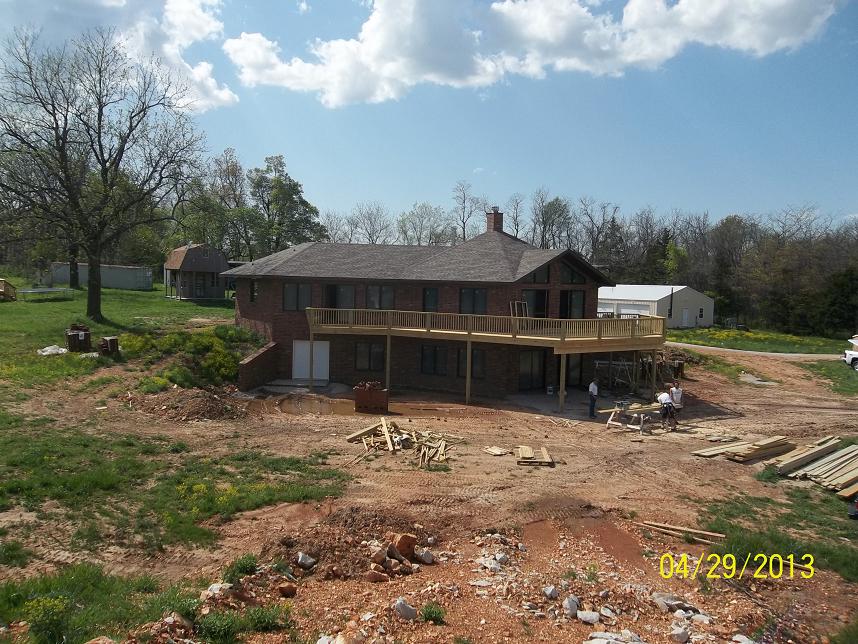
Thursday, August 8, 2013

Closing on the house

Yes! We are finally ready to close on the house! I spoke to the bank (actually, the banker) yesterday and we are scheduled for closing on Tuesday. It has been a long time since we moved out to the farm, and it's kind of hard to believe that this is actually going to happen. We have been living in the garage for 18 months now, which is almost as long as we have lived in some of the houses in the past. We have watched as the house has (slowly) taken shape, little by little, and we have seen so many previous deadlines come and go. When we first moved a year ago February we thought we would be ready to move in before Thanksgiving, then Christmas, then New Year's, then by April, then before Abby's wedding in May, then by the 4th of July, and now here we are into the second week of August. Well, realistically, we are both of us very pleased at how the house has turned out. We didn't get everything we wanted, mostly because of money, but we did get almost everything in one form or another. For example, I wanted the fireplace in the basement to heat the whole house, but it turns out that no one makes fireplaces that do that, any more. But, we did get a fireplace that will heat the downstairs family room, and the upstairs living room. So, that is almost as good. It's a very nice fireplace that is air-tight. That means that it draws all of its combustion air from an outside vent, so it doen't take the warm air from the house to burn the fire. It has vents on the front to heat the family room and it has two vents that go up inside the fireplace to the living room floor upstairs.
You may notice that the mantle is a reddish wood.  I cut the mantle out of part of the cedar tree that was growing where the house is now located.  They had to take the tree out in order to put the house there.  It was about 60 feet tall and it had a double trunk.  Each trunk was about 24 inches in diameter at the base.  I cut up one trunk to make the boards that line the master closet, and part of that went to make the mantle for the fireplace.

Right here would be the photo I took of the tree before it was cut down, but for some reason it won't load.  So, just use your imagination.

Getting back to the wood cookstove, there is a bit of a story about the heat shielding around the stove.  Most of the time the wood cookstove in a house would be located in the middle of a big eat-in kitchen.  The kitchen would be big and square, and the cookstove would occupy the middle of the room.  It wouldn't be anywhere near the walls because it gets very hot when there is a fire in it.  The cast iron absorbs heat slowly and then gives it up slowly into the room.  For that reason most cookstoves would be used a lot in the winter when the heat is needed, and everyone would crowd into the kitchen during the winter because when the stove is going, the kitchen would be warm even when the rest of the house would be cold.  During the summer, many people would have a "summer kitchen" in a separate building out away from the house with its own cookstove.  That place would have lots of windows to let the heat out, and the cookstove in the house would not be used, or only rarely, to keep from heating up the house even more in hot weather.

So, in my little kitchen, the cookstove found its place in the corner over by the front hall.  So, it had to have some kind of heat shielding to protect the surrounding walls from the heat.  Our builder came up with the idea of using cement board around it, then covering the cement board with ceramic tiles.  There is no sheetrock there at all, just the cement board attached to the studs.

You can see that the cookstove is on a raised steel platform.  That helps to distribute the weight, and it gets it up to about the same level as the other kitchen countertops.  I guess the women who used these cookstoves a hundred years ago were shorter than people are today.  Remember, this is a real antique stove, made about 1900.  Wood cookstoves were used in many rural areas of the country until the 1950's, when electricity became commonly available.

With all the rain we have been having this last week the pond is quite a bit higher.  It's not full yet, but it is almost up to where it was in the spring before we had all that dry weather.  It makes the fish happy, they are discovering places in the pond that they haven't explored before.  I hope the water stays high until fall.  Then, when we get the fall and winter rains and the snow maybe it will fill up the rest of the way.  It should be about 1/3 of an acre when it is completely full.  That will give the fish enough room to reproduce, and to survive cold weather.  They need at least 8 feet of depth in order to make it through the winter.  The water at the bottom stays warmer, since it is close to the earth.  If this continues to do well, and the fish survive until next spring, then I will add large mouth bass to the mix.  The bass will help to keep the bluegill and the catfish from producing too many fish, as they will eat the small ones.  Then, in another year or two, the bass will be big enough to fish out (dinner for me).  Even so, I think the catfish and bluegill should be big enough by next summer for me to fish for them.  I like fresh fish.  I am not a fisherman by any means, but I like to eat fish.

Thursday, July 25, 2013

Yesterday Brenda and I were working on grading the dirt around the back (the walkout side) of the new house.  When we get it all smoothed out we will spread grass seed and straw.  We will not be watering it, as that wouldn't do any good.  When it starts raining in the fall, the seed should sprout.  I got to use the tractor with the front-end loader, and that left Brenda with the shovel and the rake.  I think I got the better end of that deal.  Lots of rocks.  Even though this was all topsoil, it is amazing the quantity of rocks in there.  That's one thing you never have to worry about here in the Ozarks, is running out of rocks.  That's why the farms around here are growing hay and cattle.  That's about it.  Not enough dirt to plow.

This is my wood-fired cookstove in the new kitchen.  I hope to use the wood stove during the cooler months when a bit of warmth from the kitchen stove will feel good, and then use the electric stove during the summer when it is hot.  It is a cabinet Glenwood number 8.  I like the looks of the cabinet style, rather than the kind with legs, and it gives me a storage space under the oven for my cast iron cookware.  It doesn't have a hot water resevoir, but I will have a 2 gallon teakettle on the stove when it is being used, so I will have plenty of hot water.  It's not all hooked up yet, so after the stovepipe is installed, and we have moved into the new house I will build a fire in the firebox and see if it works.  I got it through a place called "The Love Barn" antique stoves, http://antiquecookstove.com/

They did an excellent job of tearing it down and rebuilding it so it should function better than it did when it was new.  Highly recommended if you are in the market for a real antique cookstove.  If you buy a brand new one, you won't find one like mine.  They really don't make them like that any more.

Tuesday, July 23, 2013

It's a beautiful sunny day today, not so good for the fish, who really need a lot more rain in the pond, but it's great for solar power!  Yesterday I was feeding the fish when I noticed some small plants growing on the shallow side of the pond.  Some were rushes, lots of small ones, where the dry wash goes into the pond from the upper pasture.  Some others looked like arrowhead plants.  The funny thing is, this is a new farm pond.  There has never been a pond there before, to my knowledge, although there was a low spot there that was always kind of swampy in wet weather.  So this is a new pond, lots of bare dirt, no pond plants, and yet, there they are!  I am assuming that the seeds have been transported into the pond dirt by wind or water birds, and they have taken root.  I have spent a lot of money and work to plant pond plants in the pond, some are doing well, and others didn't make it, and here are very nice pond plants that just appeared all by themselves.  Go figure.  The one, the rushes, are called spike rushes.  My  Missouri pond book says this is a very good plant to have in the pond, as it makes a nice green carpet on the pond bottom and helps to prevent weeds from growing in the pond.

I have been taking photos of all the wildflowers I find on our property.  I have a Missouri wildflowers book and I have been trying to identify them all, but some of them don't seem to be in the book.  I know the ox-eye daisy, black-eyed Susan, butterfly weed, milkweed, wild carrot (Queen Anne's lace), mullein, morning glory, horse nettle, red clover, wild strawberry, blackberry, thistle, wild rose, and I just saw bee balm starting to bloom.  It is so much fun for me to walk through the pasture and see such a wide variety of wildflowers there.

Now, of course, the pasture has been mowed and baled by our neighbor, Clifford White, so the flowers aren't visible any more until next year.

They came to do the final cleaning yesterday in the new house.  There are still a lot of details that have yet to be finished, so we're not there, yet.  Like doorknobs, paint to be touched up, the yard to be seeded, stuff like that.

Here's a photo of the solar panels being installed on the garage/workshop roof.
The crew from Straight Up Solar did a fantastic job.  They got the whole thing done in just a little more than one day.

Monday, July 22, 2013

Allow me to introduce myself as this is my first post.  I am a physician at the Federal Medical Center in Springfield, Missouri, where I have worked for about 15 years.  My wife, Brenda, works at the Pat Jones YMCA.  We have five children who are all grown and out of the house.  We started doing foster care about 6 years ago, and plan to get more foster kids when the house is done.  Brenda and I are believers in Jesus the Son of God, and we are very passionate about our faith.  We enjoy life on the farm and we hope to use the farm experience to give foster kids a place to call their home while they are away from their own home.  Brenda and I enjoy our little 12 acre hobby farm and we plan to grow most of our own food.  We bought the property about 6 years ago and have been working on getting things set up little by little.  We have 10 acres of pasture and 2.5 acres of woods.  We are building a new house (almost done) and we have been living in the garage/workshop for about 18 months while the house is being built.  Our vision is to be semi-independent, as we have our own water (well) everything is electric (except the cars) and we hope to grow most of our own food through gardening, fruit trees and wild berries, and livestock.  We have 10 chickens, one bee hive and fish in the pond.  Someday we hope to have cows and pigs, as well.

Today I realized that we are using more electricity that I thought.  We got the solar panels installed by Straight Up Solar out of St. Louis last Monday and Tuesday.  Thursday Dwight from Southwest Electric Co-op came out and installed the electric meter for the solar panels.  When I got home on Thursday I flipped the big switch to turn the solar panels on, and nothing happened.  So, I turned it off again and went to bed, wondering why it wasn't working.  Friday morning as I was going out the door to go to work, I decided to give it another shot, so I flipped the switch on again and went to work.  When I got home I saw that the solar panels really were working, but it just doesn't show on the meter, as it only reads in Kwh (kilowatt hours).  It's a new style digital meter, not the old one with the little wheel that turns inside it.  Anyway, it was reading 30.  So during the day it produced 30 Kwh of electricity.  The other meter, the one that reads our usage from the grid, was reading 396.  The day before it was 394, so we had used 2 Kwh of electricity.  Well, as I was thinking about this today I realized that there is no way we could have used 2 Kwh of electricity in one day.  That's 60 Kwh per month, 720Kwh per year.  No way.  We normally use about 34 Kwh of electricity per day, on average.  What I think it happening, is that it is subtracting one to get the other.  That is, we used 32 and it took off the 30 we produced.  That is much more likely, as we are living in the garage while the house is under construction, and the air conditioning  is on full blast in both places right now, as well as lights, and water pump, and the electricity the construction crew uses every day.  Once the construction is done and we move into the house, we turn off the air in the workshop/garage and turn the temp up during the daytime, our electric usage should go way down.  I figure an easy way to test this would be to just turn the solar panels for one day and watch the result on the usage meter, as I really haven't paid that much attention to it before now.

The solar panels are designed to produce all the electricity we use during the year.  We are "grid-tied" so we don't have batteries.  If (when) the grid goes down we will use our gasoline-powered emergency generator to run essential things like heat, lights, refrigerator, and so on until it comes back on again.  I figure we use about 11,000Kwh per year, or about 34 per day, on average.  During the hottest time of year, in July and August, we will probably use all of that 34 for air conditioning.  When the weather is cooler we will produce about 30 and use only 2-3 per day.  We will then use more during cold weather (heat pump).  We have 30 240 watt panels on the garage roof producing a total of 7,200 watts of electricity.  Of course, that is the design max, it doesn't ever actually produce that much due to various inefficiencies in the system.  And, the sun doesn't shine from directly overhead all 14 hours of the day.  So, the most it will produce is about 6,500 watts at high noon (standard time) and less as the sun is farther away from its zenith.  The idea is to reduce our electric usage to match the production from the solar panels so we aren't buying electricity and we aren't producing any extra.  It doesn't pay to produce more than we need as solar electricity is expensive and coal is cheap (up front cost).  At a final cost to us of about $25,000, saving about $200 per month, it should pay off in 7-10 years.  With a life expectancy of about 25 years that gives us a benefit of about $35,000 during the life of the solar panels (that is, we should get about $35,000 worth of "free" electricity).

I will add photos of the installation and the meters on my next post.